
<body><script type="text/javascript"> function setAttributeOnload(object, attribute, val) { if(window.addEventListener) { window.addEventListener('load', function(){ object[attribute] = val; }, false); } else { window.attachEvent('onload', function(){ object[attribute] = val; }); } } </script> <div id="navbar-iframe-container"></div> <script type="text/javascript" src="https://apis.google.com/js/platform.js"></script> <script type="text/javascript"> gapi.load("gapi.iframes:gapi.iframes.style.bubble", function() { if (gapi.iframes && gapi.iframes.getContext) { gapi.iframes.getContext().openChild({ url: 'https://www.blogger.com/navbar/6714928357359339768?origin\x3dhttp://thefiveminutes.blogspot.com', where: document.getElementById("navbar-iframe-container"), id: "navbar-iframe" }); } }); </script>

Thursday, August 5, 2010


Gravitation, or gravity, is one of the four fundamental interactions of nature (along with the strong force, electromagnetism and the weak force), in which objects with mass attract one another.[1] In everyday life, gravitation is most familiar as the agent that gives weight to objects with mass and causes them to fall to the ground when dropped. Gravitation causes dispersed matter to coalesce, thus accounting for the existence of the Earth, the Sun, and most of the macroscopic objects in the universe. Gravitation is responsible for keeping the Earth and the other planets in their orbits around the Sun; for keeping the Moon in its orbit around the Earth; for the formation of tides; for natural convection, by which fluid flow occurs under the influence of a density gradient and gravity; for heating the interiors of forming stars and planets to very high temperatures; and for various other phenomena observed on Earth.
Modern physics describes gravitation using the general theory of relativity, in which gravitation is a consequence of the curvature of spacetime which governs the motion of inertial objects. The simpler Newton's law of universal gravitation provides an accurate approximation for most calculations.

~ { 11:43 PM }
DOMO-KUN is <3


Sunday, August 1, 2010


Dry friction resists relative lateral motion of two solid surfaces in contact. The two regimes of dry friction are static friction between non-moving surfaces, and kinetic friction (sometimes called sliding friction or dynamic friction) between moving surfaces.
Coulomb friction, named after Charles-Augustin de Coulomb, is an approximate model used to calculate the force of dry friction. It is governed by the equation:
F_\mathrm{f} \leq \mu F_\mathrm{n}
where
  • F_\mathrm{f}\, is the force exerted by friction (in the case of equality, the maximum possible magnitude of this force).
  • \mu\, is the coefficient of friction, which is an empirical property of the contacting materials,
  • F_\mathrm{n}\, is the normal force exerted between the surfaces.
The Coulomb friction F_\mathrm{f}\, may take any value from zero up to \mu F_\mathrm{n}\,, and the direction of the frictional force against a surface is opposite to the motion that surface would experience in the absence of friction. Thus, in the static case, the frictional force is exactly what it must be in order to prevent motion between the surfaces; it balances the net force tending to cause such motion. In this case, rather than providing an estimate of the actual frictional force, the Coulomb approximation provides a threshold value for this force, above which motion would commence. This maximum force is known as traction.
The force of friction is always exerted in a direction that opposes movement (for kinetic friction) or potential movement (for static friction) between the two surfaces. For example, a curling stone sliding along the ice experiences a kinetic force slowing it down. For an example of potential movement, the drive wheels of an accelerating car experience a frictional force pointing forward; if they did not, the wheels would spin, and the rubber would slide backwards along the pavement. Note that it is not the direction of movement of the vehicle they oppose, it is the direction of (potential) sliding between tire and road.
In the case of kinetic friction, the direction of the friction force may or may not match the direction of motion: a block sliding atop a table with rectilinear motion is subject to friction directed along the line of motion; an automobile making a turn is subject to friction acting perpendicular to the line of motion (in which case it is said to be 'normal' to it). The direction of the static friction force can be visualized as directly opposed to the force that would otherwise cause motion, were it not for the static friction preventing motion. In this case, the friction force exactly cancels the applied force, so the net force given by the vector sum, equals zero. It is important to note that in all cases, Newton's first law of motion holds.

~ { 8:32 PM }
DOMO-KUN is <3


Dry friction resists relative lateral motion of two solid surfaces in contact. The two regimes of dry friction are static friction between non-moving surfaces, and kinetic friction (sometimes called sliding friction or dynamic friction) between moving surfaces.
Coulomb friction, named after Charles-Augustin de Coulomb, is an approximate model used to calculate the force of dry friction. It is governed by the equation:
F_\mathrm{f} \leq \mu F_\mathrm{n}
where
  • F_\mathrm{f}\, is the force exerted by friction (in the case of equality, the maximum possible magnitude of this force).
  • \mu\, is the coefficient of friction, which is an empirical property of the contacting materials,
  • F_\mathrm{n}\, is the normal force exerted between the surfaces.
The Coulomb friction F_\mathrm{f}\, may take any value from zero up to \mu F_\mathrm{n}\,, and the direction of the frictional force against a surface is opposite to the motion that surface would experience in the absence of friction. Thus, in the static case, the frictional force is exactly what it must be in order to prevent motion between the surfaces; it balances the net force tending to cause such motion. In this case, rather than providing an estimate of the actual frictional force, the Coulomb approximation provides a threshold value for this force, above which motion would commence. This maximum force is known as traction.
The force of friction is always exerted in a direction that opposes movement (for kinetic friction) or potential movement (for static friction) between the two surfaces. For example, a curling stone sliding along the ice experiences a kinetic force slowing it down. For an example of potential movement, the drive wheels of an accelerating car experience a frictional force pointing forward; if they did not, the wheels would spin, and the rubber would slide backwards along the pavement. Note that it is not the direction of movement of the vehicle they oppose, it is the direction of (potential) sliding between tire and road.
In the case of kinetic friction, the direction of the friction force may or may not match the direction of motion: a block sliding atop a table with rectilinear motion is subject to friction directed along the line of motion; an automobile making a turn is subject to friction acting perpendicular to the line of motion (in which case it is said to be 'normal' to it). The direction of the static friction force can be visualized as directly opposed to the force that would otherwise cause motion, were it not for the static friction preventing motion. In this case, the friction force exactly cancels the applied force, so the net force given by the vector sum, equals zero. It is important to note that in all cases, Newton's first law of motion holds.

~ { 8:30 PM }
DOMO-KUN is <3


In physics, a force is any influence that causes a free body to undergo an acceleration. Force can also be described by intuitive concepts such as a push or pull that can cause an object with mass to change its velocity (which includes to begin moving from a state of rest), i.e., to accelerate, or which can cause a flexible object to deform. A force has both magnitude and direction, making it a vector quantity. Newton's second law, F=ma, can be formulated to state that an object with a constant mass will accelerate in proportion to the net force acting upon and in inverse proportion to its mass, an approximation which breaks down near the speed of light. Newton's original formulation is exact, and does not break down: this version states that the net force acting upon an object is equal to the rate at which its momentum changes.[1]
Related concepts to accelerating forces include thrust - any force which increases the velocity of the object, drag - any force which decreases the velocity of any object, and torque - the tendency of a force to cause changes in rotational speed about an axis. Forces which do not act uniformly on all parts of a body will also cause mechanical stresses,[2] a technical term for influences which cause deformation of matter. While mechanical stress can remain embedded in a solid object, gradually deforming it, mechanical stress in a fluid determines changes in its pressure and volume.[3][4]
Philosophers in antiquity used the concept of force in the study of stationary and moving objects and simple machines, but thinkers such as Aristotle and Archimedes retained fundamental errors in understanding force, due to an incomplete understanding of the sometimes non-obvious force of friction, and a consequently inadequate view of the nature of natural motion.[5] Some of these misunderstandings were corrected during the Middle Ages; for example, Al-Baghdadi's version of the theory of impetus correctly theorized that force is proportional to acceleration.[6] Most of the previous misunderstandings about motion and force were eventually corrected by Sir Isaac Newton; with his mathematical insight, he formulated laws of motion that remained unchanged for nearly three hundred years.[4] By the early 20th century, Einstein developed a theory of relativity that correctly predicted the action of forces on objects with increasing momenta near the speed of light, and also provided insight into the "forces" produced by gravitation and inertia.

Forces are also described as a push or pull on an object. They can be due to phenomena such as gravity, magnetism, or anything else that might cause a mass to accelerate.

~ { 8:27 PM }
DOMO-KUN is <3


Units


Mercury column
The SI unit for pressure is the pascal (Pa), equal to one newton per square meter (N/m2 or kg·m-1·s-2). This special name for the unit was added in 1971;[3] before that, pressure in SI was expressed simply as N/m2.
Non-SI measures such as pounds per square inch and bar are used in some parts of the world, primarily in the United States of America. The cgs unit of pressure is the barye (ba), equal to 1 dyn·cm-2. Pressure is sometimes expressed in grams-force/cm2, or as kg/cm2 and the like without properly identifying the force units. But using the names kilogram, gram, kilogram-force, or gram-force (or their symbols) as units of force is expressly forbidden in SI. The technical atmosphere (symbol: at) is 1 kgf/cm2. In US Customary units, it is 14.696 psi.
Some meteorologists prefer the hectopascal (hPa) for atmospheric air pressure, which is equivalent to the older unit millibar (mbar). Similar pressures are given in kilopascals (kPa) in most other fields, where the hecto- prefix is rarely used. The inch of mercury is still used in the United States. Oceanographers usually measure underwater pressure in decibars (dbar) because an increase in pressure of 1 dbar is approximately equal to an increase in depth of 1 meter. Scuba divers often use a manometric rule of thumb: the pressure exerted by ten meters depth of water is approximately equal to one atmosphere. Americans learn that 34 feet of fresh water or 33 feet of sea water equals one atm.
The standard atmosphere (atm) is an established constant. It is approximately equal to typical air pressure at earth mean sea level and is defined as follows:
standard atmosphere = 101325 Pa = 101.325 kPa = 1013.25 hPa.
Because pressure is commonly measured by its ability to displace a column of liquid in a manometer, pressures are often expressed as a depth of a particular fluid (e.g., inches of water). The most common choices are mercury (Hg) and water; water is nontoxic and readily available, while mercury's high density allows for a shorter column (and so a smaller manometer) to measure a given pressure. The pressure exerted by a column of liquid of height h and density ρ is given by the hydrostatic pressure equation p = ρgh. Fluid density and local gravity can vary from one reading to another depending on local factors, so the height of a fluid column does not define pressure precisely. When millimeters of mercury or inches of mercury are quoted today, these units are not based on a physical column of mercury; rather, they have been given precise definitions that can be expressed in terms of SI units. One mmHg (millimeter of mercury) is equal to one torr. The water-based units still depend on the density of water, a measured, rather than defined, quantity. These manometric units are still encountered in many fields. Blood pressure is measured in millimeters of mercury in most of the world, and lung pressures in centimeters of water are still common.
Gauge pressure is often given in units with 'g' appended, eg 'kPag' or 'psig', and units for measurements of absolute pressure are sometimes given a suffix of 'a', to avoid confusion, for example 'kPaa', 'psia'.

~ { 8:21 PM }
DOMO-KUN is <3


interestingz pressure !!!

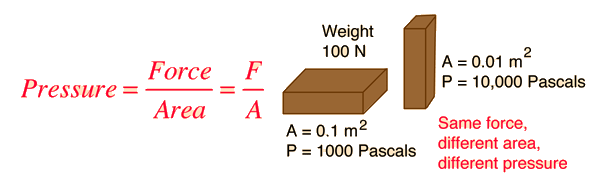
Pressure is defined as force per unit area. It is usually more convenient to use pressure rather than force to describe the influences upon fluid behavior. The standard unit for pressure is the Pascal, which is a Newton per square meter.

For an object sitting on a surface, the force pressing on the surface is the weight of the object, but in different orientations it might have a different area in contact with the surface and therefore exert a different pressure.

This is a short intro of pressure ...

~ { 8:20 PM }
DOMO-KUN is <3


force and pressure

Pressure is the force on an object that is spread over a surface area. The equation for pressure is the force divided by the area where the force is applied. Although this measurement is straightforward when a solid is pushing on a solid, the case of a solid pushing on a liquid or gas requires that the fluid be confined in a container. The force can also be created by the weight of an object.

When you apply a force to a solid object, the pressure is defined as the force applied divided by the area of application. The equation for pressure is:

P = F/A

where

  • P is the pressure
  • F is the applied force
  • A is the surface area where the force is applied
  • F/A is F divided by A

For example, if you push on an object with your hand with a force of 20 pounds, and the area of your hand is 10 square inches, then the pressure you are exerting is 20 / 10 = 2 pounds per square inch.

Pressure equals Force divided by Area

Pressure equals Force divided by Area

You can see that for a given force, if the surface area is smaller, the pressure will be greater. If you use a larger area, you are spreading out the force, and the pressure (or force per unit area) becomes smaller.

Solid pressing on confined fluid

When a liquid or gas is confined in a container or cylinder, you can create a pressure by applying a force with a solid piston. The pressure created in the cylinder equals the force applied divided by the area of the piston: P = F/A.

In a confined fluid—neglecting the effect of gravity on the fluid—the pressure is the same throughout the container, pressing equally on all the walls. In the case of a bicycle pump, the pressure created inside the pump will be transmitted through the hose into the bicycle tire. But the air is still all confined.

Pressure is in all directions in a fluid

Pressure is in all directions in a fluid

Increasing the force will increase the pressure inside the cylinder.

Caused by gravity

Since the weight of an object is a force caused by gravity, we can substitute weight in the pressure equation. Thus the pressure (P) caused by the weight (W) of an object is that weight divided by the area (A) where the weight is applied.

P = W/A

If you place a solid object on the floor, the pressure on the floor over the area of contact is the weight of the object divided by the area on the floor.

Pressure equals Weight divided by Area

Pressure equals Weight divided by Area

Example with shoes

A good example of how a force on small area can result in a very high pressure is seen in women's shoes with high spiked heels. These types of shoes can cause damage to some floors due to the very high pressure on the floor at the heel.

An average shoe distributes the weight of the person over 20 square inches. Thus, a 100-pound person applies 100/20 = 5 pounds per square inch on the floor.

Since a spike-heel is only 0.25 square inches, the 100-pound person would be applying 100/0.25 = 400 pounds per square inch on the floor at the heel! In some cases, that is sufficient to damage the floor.

) A needle will exert enormous pressure because the surface area (A) of the point where the force (F) is being applied is very small. That's why it penetrates skin and other materials.

2) If your mass is 50 kg , what is the pressure you exert on the ground when you are standing up, assuming that the surface area of your shoes is 0.05 m2.

Answer:

(remember that mass is not the same as weight)

Assuming that g =10 m/s2 , F = 50kg x 10 m/s2 = 500 N (weight)

A = 0.05 m2

P = F/A = 500 N / 0.05 m2 = 10000 N / m2

3) A jack is projected to lift a bus which has a mass of 4 000 kg. If the large piston (the one that moves up in the animation) has an area of 1 m2 , and the small piston on the other end of the circuit has an area of 0.05 m2 , what is the minimum force that must be applied (to the little piston) in order to lift the bus?

Answer: We want find out a force, which is given by : F = P x A . P is the same in the whole circuit , and to do this exercise we don't need to know its value so that we will simply call it P.

Lets call the force on the small piston Fs and the force on the large piston Fl. Likewise, the area of the small piston will be called As and the area of the large piston Al. Because the pressure (P)is the same in both pistons we can write:

Fs = As x P and

Fl= Al x P

We know the areas (As = 0.05 m2and Al = 1 m2), so that we can substitute them in the equations:

Fs = 0.05 m2 x P

Fl = 1 m2 x P

We have 2 equations and 2 unknowns.It is a system.From now on you will have to use your maths skills. You could even pretend that you have x's and y's instead of F's , A's and P's , if it makes things easier to you.

There are many ways to solve this system . We will do it by dividing the top equation by the bottom one:

Fs / Fl = 0.05 / 1

That is all (Remember that P / P = 1) .

So,

Fs / Fl = 0.05

Rearranging:

Fs = 0.05 Fl

In order to lift the bus , the force on the large piston (Fl) must be al least 40 000 N (because the mass of the bus is

4 000 kg). So,

Fs = 0.05 x 40 000

Fs = 2 000 N (Final answer)

This example illustrates how a small force can be multiplied many times by using a hydraulic jack. This is the type of calculation that mechanical engineers do.

Fluid weight

If you put a liquid in a container, the weight of that liquid would be pressing on the bottom of the container similar to that of the weight of a solid object. The pressure on the bottom of the container would be the same as if the weight was from a solid: P = W/A.

The only difference is that pressure in a fluid goes in all directions. So the pressure on the sides at the bottom would be the same.

Gases and liquids exhibit pressure due to their weight at every point in the fluid.

Summary

To end it off, Pressure is the force on an object that is spread over a surface area. The equation for pressure is P = F/A. Pressure can be measured for a solid is pushing on a solid, but the case of a solid pushing on a liquid or gas requires that the fluid be confined in a container. The force can also be created by the weight of an object.

done by : qi hui

http://www.school-for-champions.com/science/pressure.htm

http://sci-culture.com/advancedpoll/GCSE/hyd.htm


~ { 8:05 PM }
DOMO-KUN is <3