
photo, hello.
hello. we are from canberra secondary school. :D
we are from class 1E3. :D
our group consists of Ghadaffi, Kaiyuan, Qihui, Julia & Syakirah.
Image -- wikipedia | domo-kun fan site
Brushes -- 1
Skins -- Blogskins
Fonts -- Dafont
Layout & Design -- yiNgz~
coming soon.
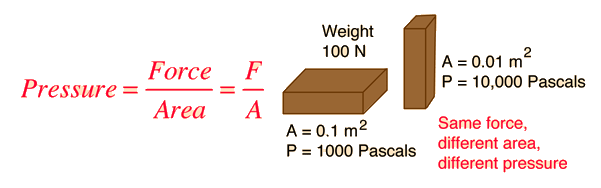
Pressure is defined as force per unit area. It is usually more convenient to use pressure rather than force to describe the influences upon fluid behavior. The standard unit for pressure is the Pascal, which is a Newton per square meter.
For an object sitting on a surface, the force pressing on the surface is the weight of the object, but in different orientations it might have a different area in contact with the surface and therefore exert a different pressure.